Uploaded by Nathalie Kalina
Introduction Activities for Birch Bark Biting
by Jessica Wesaquate and Andrea Rogers
Engage (Set) Activities:
Encourage students to work in groups, then share with the class. This will
foster more of an Aboriginal approach to teaching/learning.
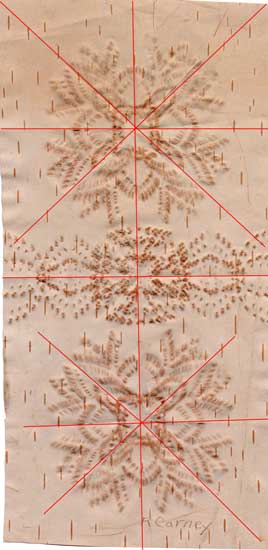
- Blow-up copies of birch bark biting as visuals; students can volunteer
to use their fingertip (or ruler, meter stick) to show where the lines of
symmetry are. - Have samples of birch bark biting that you can pass around the class for
the students to see (adapts to the senses, allows them to feel, see, smell) - In a web, or general discussion, have students brainstorm
what symmetry, and lines of symmetry are. Students can work in groups to create their
own definitions. Then give formal definitions, and explain. - Where do we see symmetry in the classroom? Go
outside, where does mother nature provide us with symmetry, how do we know
it is symmetrical? Students can collect symmetrical items from nature and
display them around the classroom, store them in a scrapbook, or even make
a classroom mural of symmetry. - Where do we see symmetry in other Aboriginal art forms?
Provide physical or visual examples of other Aboriginal art forms where
symmetry is evident (Star blankets, moccasins, beadwork, Métis flower beadwork). Students
can work in groups to discuss the symmetry that they see.
Aboriginal Perspectives is supported by the University of
Regina, the Imperial Oil Foundation, the Canadian Mathematical Society and
the Pacific Institute for the Mathematical Sciences.