Uploaded by IsumaTV
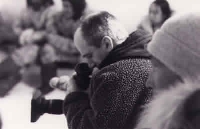
Norman Cohn (b. 1946, New York) is secretary-treasurer and co-founder of Igloolik Isuma’s collective.
I
am Isuma's fourth and only non-Inuit partner. I came to Igloolik in the
mid-80's to meet Zach and Apak, whose early videos I had seen by
accident in Montreal. I was looking for a context in which to work that
was more serious than the exclusively self-referential world of
contemporary video art. I found partners with similar vision and shared
goals despite wide cultural differences. I stayed to live and co-found
Igloolik Isuma Productions.
As a marriage of art and politics, Isuma's videomaking synthesizes
several related themes in a new way. First, Inuit oral storytelling is
a sophisticated mix of fact, fiction, performance, improvisation, past
and future which has maintained Inuit culture successfully through art
from stone age to information age. Second, being colonized
offers artists a fertile reality for original progressive
self-expression. Third, the invention of low-cost video at the end of
the 1960's enabled people from Harlem to the arctic to use TV as a tool
for political and social change in local communities. Fourth, after
thirty years 'alternative' film and video finally moved from the
margins to the mainstream as techniques pioneered by filmmakers like
John Cassavetes, Peter Watkins and Leacock-Pennebaker, and by guerilla
video groups like Ant Farm, TVTV and Vidéographe now show up in the
1990's as shaky-camera bank commercials.
For four millennia Inuit have refined cooperation as a medium of
production and survival, valuing consensus and continuity over
individuality and competition. As a collective Igloolik Isuma
Productions arrives at the millennium practicing respectful cooperation
as a formal element of our media art. We implant these values - our
collective process - in our filmmaking practice; community support and
participation are qualities of production we make visible on the
screen. We extend these same values to cross-cultural collaboration. As
artists bridging the past and future we practice a third way, different
from either the Inuit way or the Government way, two solitudes
separated by centuries of fear and mistrust since Columbus and
Frobisher 'discovered' the New World. Inuit skills of working together
join with southern ideas of community videomaking in a new model of
professional production that can change TV.