Uploaded by Nathalie Kalina
Director Eats Set
By SF Said
Monday, April 11, 2005
Shooting a film inside an igloo poses some unique
problems. Movie cameras are delicate pieces of equipment. They need to be kept
dry, secure, and at a constant temperature.
Camera Assistant Felix Lajeunesse is spending a lot of
time on these problems. He tells me that on Thursday night, the camera was
stored overnight in the Igloo Snow Palace. In the morning, there was a layer of
ice in front of the lens, and the camera took 2 hours to warm up. On Friday
night, it was stored in the catering tent that's been pitched near the Ice
Palace; a gas stove burns all night there. It was better in the morning; only
an hour to warm up this time. An ideal solution has yet to be found.
There are advantages to igloo shooting, though. Richard
Lavoie says his sound recording equipment is unaffected by the temperatures -
in fact, an igloo is ideal for his work, as all its surfaces act as absorbent
acoustic pads. "It's perfect," he says. "The sound is very clear, and there's
no echo. You can't do better than this." (Richard is in good spirits today; he
is celebrating the fact that he's still alive, because he narrowly avoided a fatal
accident on the way to the Snow Palace. He fell off his skidoo, and only
escaped being brained by the qamutik (sled) behind him because his sound
assistant Brian Nutarariaq kept holding onto his leg!
Once we're all set up, Saturday is spent shooting a long
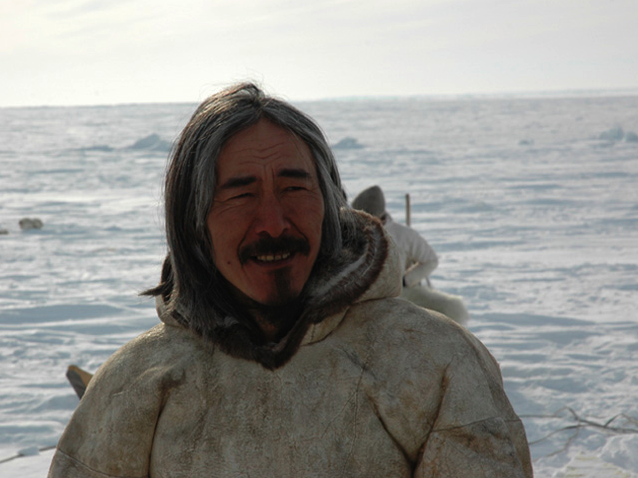
speech by the shaman Aua (Pakak Innukshuk). Pakak played the older brother
Amaqjuaq in Atanarjuat, and he brings the same combination of strength, dignity
and honesty to this role. He talks softly, but with enormous conviction; I
would believe anything he told me. He's an ideal casting choice for the great
shaman.
As in Captain Comer's cabin, this scene is being filmed
entirely without electric lights, using only natural illumination. But the
light in an igloo is very different to that in the cabin. Today, it's clean and
bright - somewhere between white, grey and blue - and it's picked up by the
white furs that the actors are wearing, as well as the clouds of breath that
come out of their mouths. Against all that whiteness, Pakaks' dark eyes become
powerful points of focus as he speaks.
The challenge of this scene is that Aua's speech is a very
substantial monologue, telling his life story, and the film-makers want to
capture it all in a single take. Pakak rises to the challenge, delivering the
speech many times during the day as Zach and Norman get many takes from
different angles, shooting it both from a tripod and hand-held. Each time, even
though I don't understand the Inuktitut, it's compelling to watch.
In a break, Zach carves slices from one of the fish on the
set, in Aua's food store. "He's eating the set," observes Norman. "That's a
headline for you: Director Eats Set!" But as Zach passes round pieces of Arctic
char, I have to admit, the set is delicious.
Pakak's scene is complete by mid-afternoon: several pages
of script have been shot in a day. I am impressed at the speed of work; with no
time wasted in setting up and changing lights and so on, most of the hours on
set are spent filming the actors perform. Perhaps this is something like the ideal
that the authors of Dogme95 had in mind: strip away the unnecessary artifice of
cinema, and get down to capturing truth on camera.